
How can policymakers enable more farmers to practice Regenerative and Conservation Agriculture?
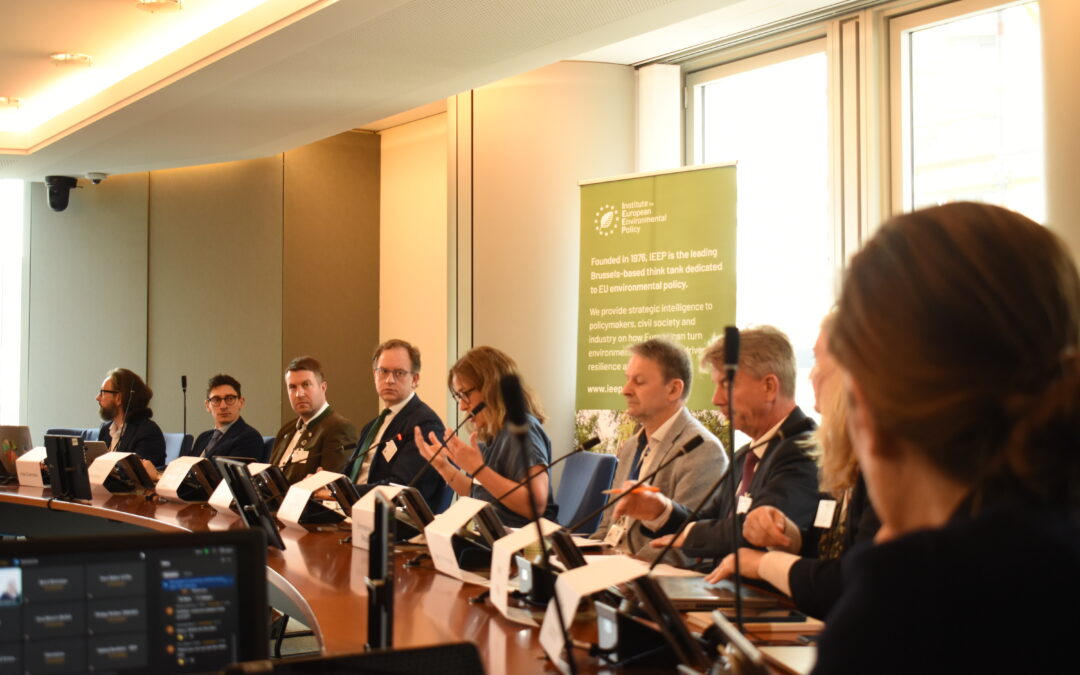
This was the question we took to European Parliament this week (9 June) at an event co-hosted by Institute for European Environmental Policy (IEEP) and the MEP Group on ‘Climate Change, Biodiversity and Sustainable Development’, and attended by representatives from the European Commission, European Parliament, the finance sector and the food industry.
Sharing practical insights from our research to support a thriving and sustainable farming sector in Europe, we showed:
- How Regenerative and Conservation Agriculture can strengthen farm income, resilience, climate adaptation, and long-term budget efficiency.
- Why the limited uptake of Regenerative and Conservation Agriculture is not due to knowledge gaps among farmers. Instead, it is because the policy environment is not enabling. Unstable policies, limited advisory support, and a gap between what policies say and what actually happens on the ground all make it harder to adopt new practices.
- How farmers face major hurdles when it comes to getting finance for Regenerative and Conservation practices. Lenders tend to look at short-term returns, but improving soil health and changing systems is a long-term process.
- Why this shift is long-term, depends a lot on local context, and needs support across the whole system. To scale Regenerative and Conservation Agriculture, policymakers need to focus on sharing risk, giving long-term policy certainty, strengthening advice and peer learning, and making sure everything aligns better across supply chains and markets.

Thank you to everyone who attended the discussion – we were very pleased to hear so many positive comments from you about the event and our research project over the lunch that followed.
If you are interested to learn more about policy issues, look out for our upcoming policy brief on how to strengthen the policy framework for Regenerative and Conservation Agriculture.