
5 Living Labs across Europe
TRAILS4SOIL takes a Living Labs approach to its research.
Our experiments take place on working farms and in close collaboration with farmers. Together, we are developing, testing, and refining innovations that address local farming and environmental challenges.
Each of our 5 Living Labs addresses a specific issue:

Permanent Crops

Organic Farming
Regenerative agriculture approaches towards organic farming systems.

Adaptation to Climate Change

Black Soil
Innovative solutions for black soil conservation

Crop-livestock Integration

Permanent Crops
Spain & Portugal
Organic Farming
Austria & Switzerland
Adaptation of Climate Change
Germany
Black Soil
Moldova, Romania & Ukraine
Crop-livestock Integration
Slovenia
Which innovations are we testing?
TRAILS4SOIL tests the performance of 21 types of Regenerative and Conservation Agriculture practices in enhancing soil health. We will also assess their socio-economic impacts – including on farm income and farmer wellbeing.
Take a look at each of our 5 Living Labs to find out which innovations we will be testing where.
Soil management
- Spontaneous groundcovers
- Sown cover crops/groundcovers
- Mulching (woody or herbaceous residues)
- Organic amendments
- Minimum tillage in organic farming
- Minimal soil disturbance/permanent soil cover
- Planting green
- Mechanical control of cover crops/groundcovers
Agronomy management
- Intercropping, mixed cropping
- Enhance diversity of crop rotations
- Adapted plant nutrient strategies (NPK,
micro nutrients, pH)
Weed control
- Alternative weed control techniques
- Adapted plant protection measures
Green infrastructure
- Multifunctional field margins/buffer zones
- Biodiversity structures
- Forest curtains
Livestock and pasture management
- Grazing
- Adapted crop rotation for enhancing self-sufficiency in animal feed
- Permanent grassland (establishing rules of Conservation Agriculture in grassland)
IT
- Precision farming (Auto-guidance, VRA)
- Modelling (digital twins, remote sensing)
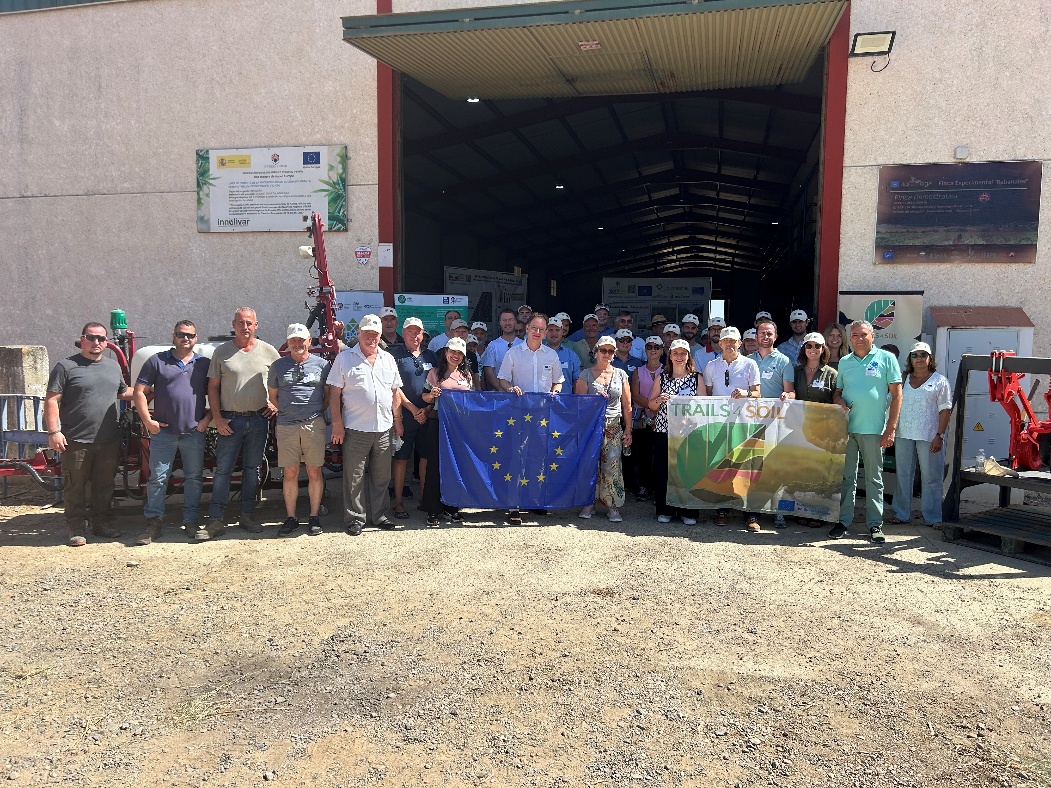
Who are we collaborating with in our Living Labs?
Farmers, industry, government, academics, NGOs and civil society are all active contributors to TRAILS4SOIL. They are involved in every step of the project – working with our researchers to develop and test agricultural practices, and shape the project’s progress. This collaborative process helps ensure that the practices are effective as well as practical, and can be adopted by farmers in other locations.
The environment as a stakeholder
TRAILS4SOIL goes beyond traditional collaborations by including the natural environment as a key stakeholder.
We ensure ecological concerns and sustainability are considered at all stage of the process, to ensure that the agricultural practices address the pressing challenges to soils, the climate and biodiversity.
Project Partners:


Newsletter: Sign up for evidence on Regenerative and Conservation Agriculture