
Work packages
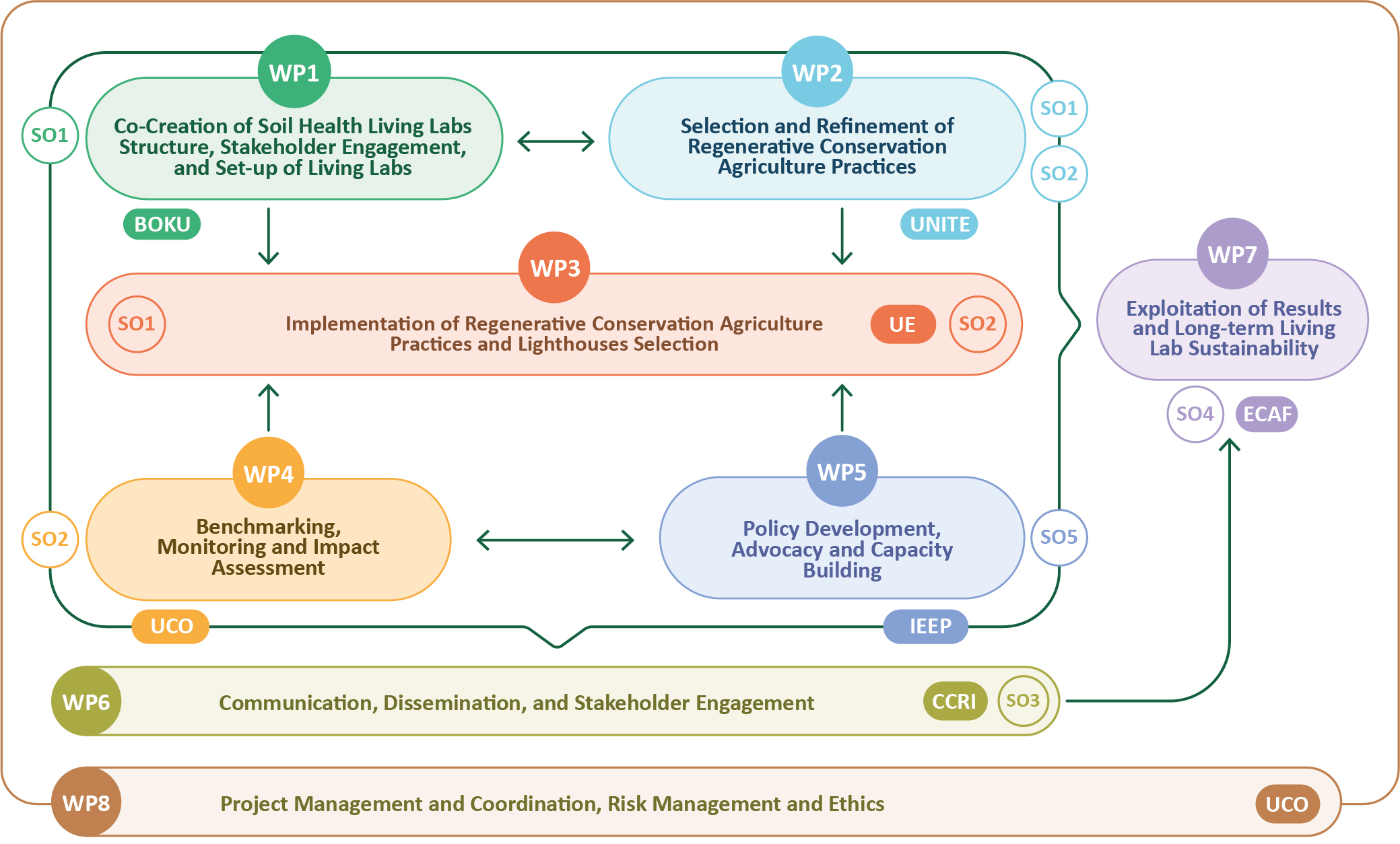
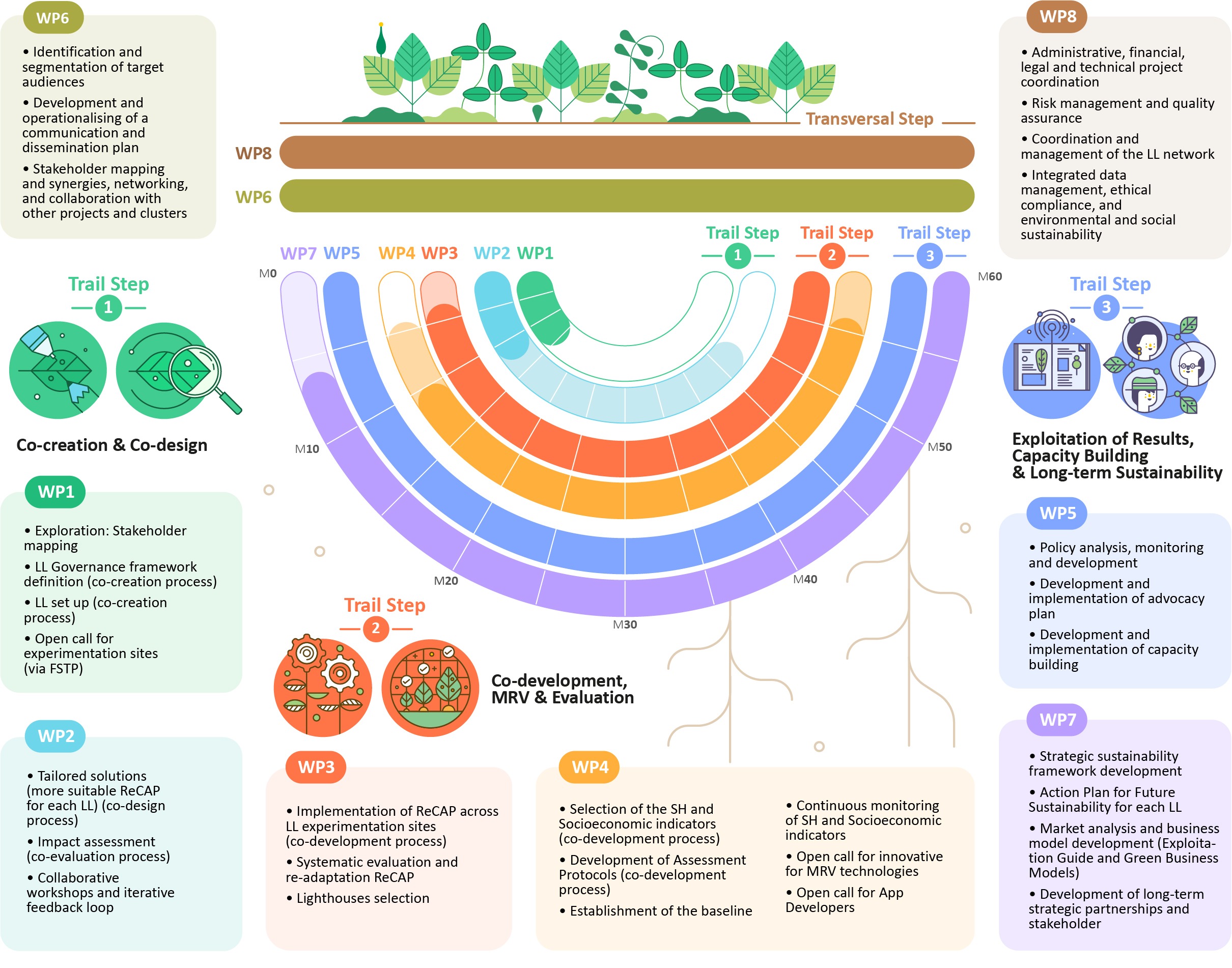
TRAILS4SOIL is comprised of 8 components, or work packages (WP).
Work package 1
Co-creation of stakeholder Living Labs structure, stakeholder engagement, and set-up of Living Labs
Led by: University of Natural Resources and Life Sciences
Objectives:
- Co-define the key challenges and stakeholder restoration objectives for TRAILS4SOIL’s Living Labs
- Map and engage stakeholders into Living Labs for participating in co-creation, co-design, and co-development processes
- Co-create the collaboration framework, roadmaps and governance structures of Living Labs.
Work package 2
Selection and Refinement of regenerative and conservation agriculture practices (ReCAP)
Led by: University of Teramo
Objectives:
- Assess and integrate the best ReCAP into the Living Labs, ensure their adaptation to local conditions through stakeholder collaboration
- Co-create and refine ReCAP with local stakeholders, developing criteria for their continuous improvement and adaptation
- Facilitate the continuous refinement of ReCAP through iterative workshops and feedback mechanisms with stakeholders.
Work package 3
Implementation of ReCAP and Lighthouses Selection
Led by: University of Evora
Objectives:
- Select and establish experimentation sites for the application of ReCAP
- Implement ReCAP effectively at all the experimentation sites through a collaborative development process
- Evaluate and adapt practices based on ongoing monitoring and stakeholder feedback
- Identify and select sites to serve as demonstration hubs (‘lighthouses’) showcasing best practices and innovations in Regenerative and Conservation Agriculture.
Work package 4
Benchmarking, Monitoring and Impact Assessment
Led by: University of Cordoba
Objectives:
- Identify a comprehensive suite of key scientifically validated indicators to assess the impact of Regenerative and Conservation Agriculture on stakeholders, ecosystem services, and socioeconomic conditions
- Develop cutting-edge assessment protocols to efficiently monitor and predict changes in stakeholder and related parameters.
- Establish robust and comprehensive baseline data for stakeholder and socioeconomic conditions in each Living Lab, enabling accurate measurement of changes over time.
- Perform continuous monitoring and comparative analysis between fields under conventional and ReCAP, to provide quantitative evidence of their impacts.
- Assess the technical, economic, and social viability of ReCAP to inform adoption strategies and policy recommendations for broader implementation across Europe.
- Ensure effective collaboration with other work packages (WP5 and WP7) to integrate data and insights into long-term sustainability plans and decision-making processes.
Work package 5
Policy Development, Advocacy, and Capacity Building
Led by: Institute for European Environmental Policy (IEEP)
Objectives:
- Develop evidence-based policy recommendations for facilitating the adoption of ReCAP.
- Advocate for the alignment of existing and, if necessary, new EU, Member State and regional policies in the Living Lab countries.
- Design and implement comprehensive training programmes for farmers, land managers, and other stakeholders.
Work package 6
Communication, Dissemination, and Stakeholder Engagement
Led by: Countryside & Community Research Institute (CCRI)
Objectives:
- Ensure a strategic approach to communication and dissemination by developing a comprehensive plan that aligns with the project’s goals.
- Create strong synergies with ongoing European initiatives and networks related to stakeholders and Regenerative and Conservation Agriculture to promote effective and efficient exchange of knowledge.
- Actively engage stakeholders across all levels (farmers, policymakers, researchers, etc.) to foster long-term involvement.
- Develop effective communication materials and strategies tailored to diverse audiences.
- Monitor and evaluate the success of dissemination activities through measurable KPIs, ensuring the highest impact.
Work package 7
Exploitation of Results and Long-term Living Lab Sustainability
Led by: European Conservation Agriculture Federation (ECAF)
Objectives:
- Develop and implement a comprehensive long-term strategic framework to ensure the sustainability of the Living Labs beyond the project’s duration.
- Identify, develop, and pilot sustainable business models that can be adopted by the Living Labs to secure their financial viability, ensuring their integration into relevant markets.
- Establish and maintain strategic partnerships and secure diverse funding sources to support the Living Labs’ ongoing operations and growth.
- Promote continuous collaboration, knowledge exchange, and capacity building among stakeholders to maximise the Living Labs’ long-term impact, relevance, sustainability, and adaptability.

Work package 8
Project Management and Coordination, Risk Management and Ethics
Led by: University of Cordoba
Objectives:
- Ensure sustainable project implementation in alignment with the defined timetable, resources, objectives, and success indicators, adhering to the highest standards of efficiency and effectiveness.
- Manage all communications, reporting, and financial administration between the project consortium and the European Commission, ensuring transparency and compliance with all contractual obligations.
- Facilitate coordination and collaboration among partners to achieve project objectives, guided by a robust Quality Management Plan and a proactive Risk Management Plan.
- Establish and maintain practical internal project management tools that play a pivotal role in supporting the smooth and efficient running of the project, ensuring all partners have the resources and support needed to fulfil their roles.
- Monitor, mitigate, and manage potential risks to the project, ensuring timely interventions and adjustments are made to maintain project alignment with its goals.
- Promote a culture of sustainability and inclusion in the project’s daily operations, ensuring that environmental, social, economic, and gender-related considerations and an inclusive approach that addresses the needs of all stakeholders are systematically incorporated into all project activities.
- Ensure rigorous quality management throughout the project, adhering to the highest standards in all deliverables and project activities, and systematically monitoring and improving processes to maintain these standards.
Newsletter: Sign up for evidence on Regenerative and Conservation Agriculture